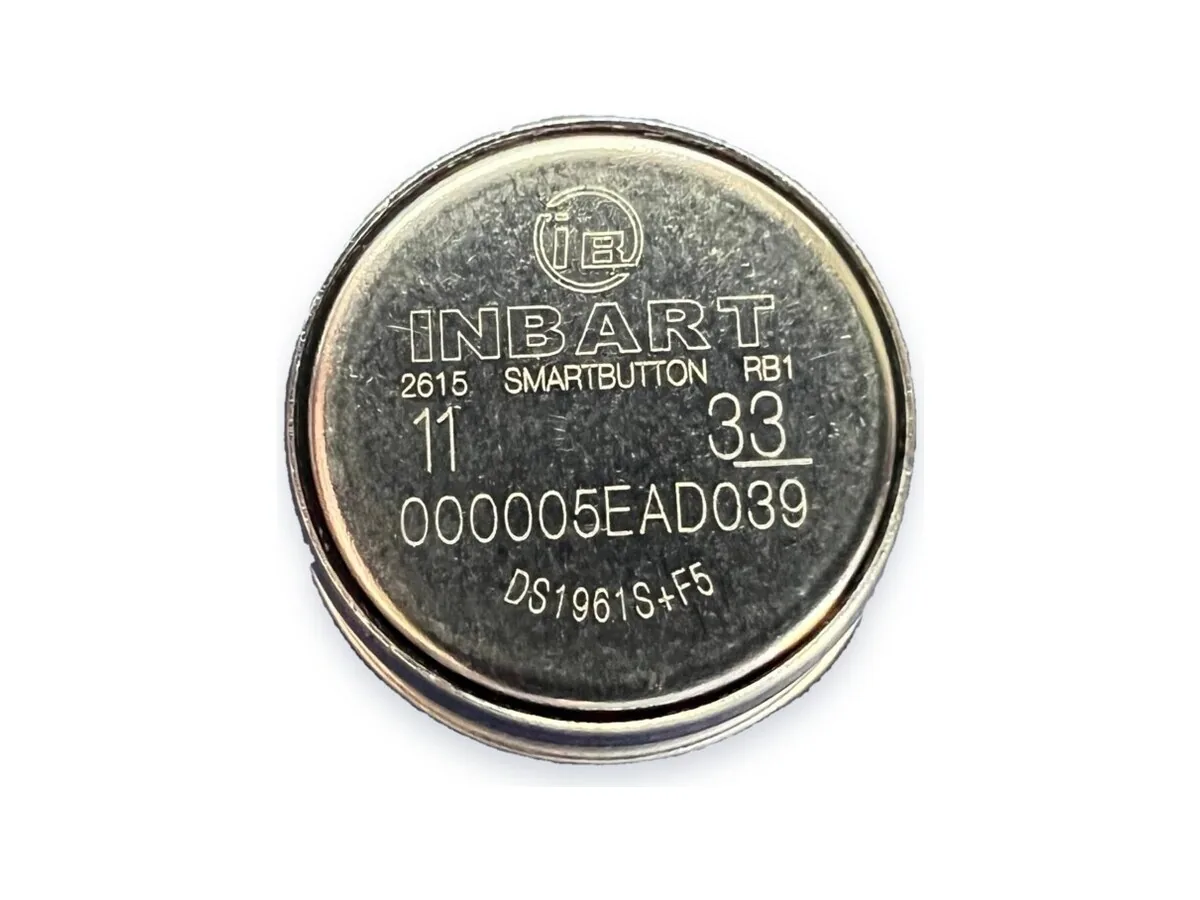
DS1961S SHA-1 Authentication iButton
1 Kb EEPROM with on-chip SHA-1 challenge–response.
Every other key in this catalogue can be cloned by anyone who can read its ID — that is simply how a serial-number token works. The DS1961S cannot. It holds a 64-bit secret that is never transmitted, and an on-chip 512-bit SHA-1 engine that answers the reader's random challenge with a 160-bit message authentication code. A copy of the ID produces the wrong MAC and the door stays shut. Writes are equally protected: the copy-scratchpad command only executes if it arrives with a matching MAC, so an attacker cannot rewrite the memory either.
The only one that cannot be cloned
This is the security answer in the range. A DS1990A, a TM1990A, even a DS1991 can be copied by someone with a duplicator and thirty seconds; the DS1961S cannot, because the reader never asks "what is your ID" — it asks "prove you know the secret", and the secret never leaves the chip. Specify it when the token opens something worth attacking: cash-handling equipment, pharmaceutical stores, high-value asset cabinets, or any system where an unauthorised duplicate would be expensive. Note that it needs a controller that implements SHA-1 authentication — in a plain ID reader it will behave like an ordinary key.
Key features
- On-chip SHA-1 engine computes 160-bit MACs for challenge/response authentication — not just an ID you can copy.
- Writes require the 64-bit secret plus a valid MAC — strong protection against unauthorised writes and cloning.
- The secret is write-only and can never be read back off the chip.
- 1 Kbit user EEPROM in 4 pages; write-protect or EPROM-emulation mode per page; on-chip 16-bit CRC.
- Family code 33h; 50,000 write/erase cycles; 10-year retention at +85 °C; 2.8–5.25 V.
- Original imported dies, canned and assembled at our own line — original-chip reliability at a sharper price; laser-etched custom marking and logos to order.
Specifications
| Chip / compatibility | DS1961S · family code 33h · shares its die with the DS2432 chip form |
|---|---|
| Memory | 1128-bit 5V EEPROM in total — 1024-bit user array (4 pages × 256 bits) + 64-bit secret + 512-bit SHA-1 engine + 8-byte register page + scratchpad; secret and data pages can be write-protected |
| Protocol | 1-Wire single-line data link to the host, ~14.1 kbit/s standard / 125 kbit/s overdrive · 160-bit MAC challenge–response on read and write |
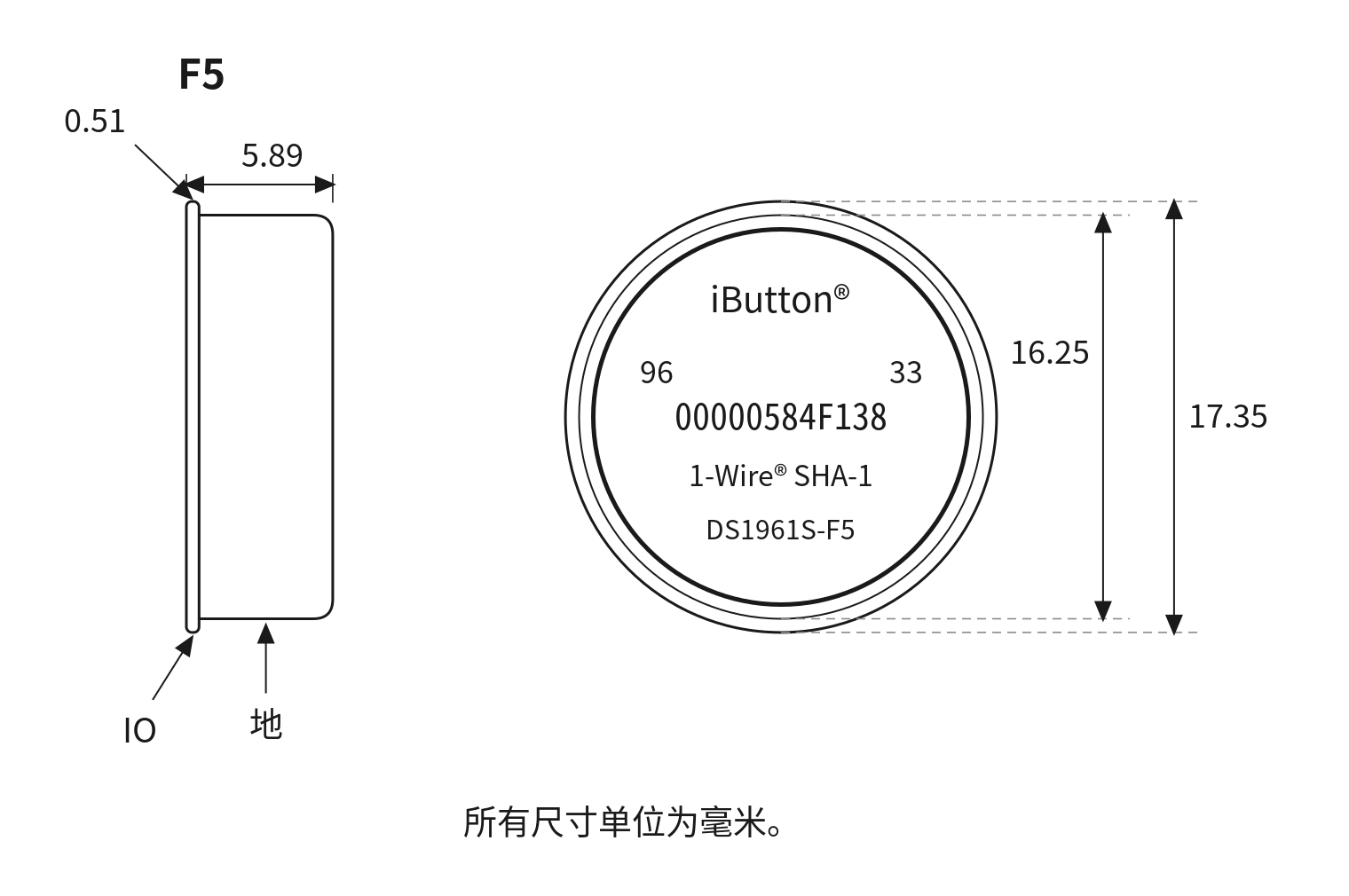
| Package | F5 can, Ø16.25 × 5.89 mm · single piece approx. 23 g packed |
| Operating temperature | −40 °C … +85 °C · data retention at least 10 years at +85 °C |
| Options | Secret can be loaded or computed on-chip, then write-protected; the same SHA-1 scheme is used by 1-Wire SHA coprocessors · laser-etched custom marking / logo on the can |
Product dimensions
Inside the stainless can
A 0.25 mm solid stainless shell, a UV-stable polypropylene grommet isolating lid from base, and the die bonded inside. Lid = data contact, base = ground return.
Which memory iButton do you need?
The whole memory range side by side, grouped by storage technology — capacities and family codes per the Analog Devices datasheets.
| Model | Family code | Capacity | Memory technology | Pick it for |
|---|---|---|---|---|
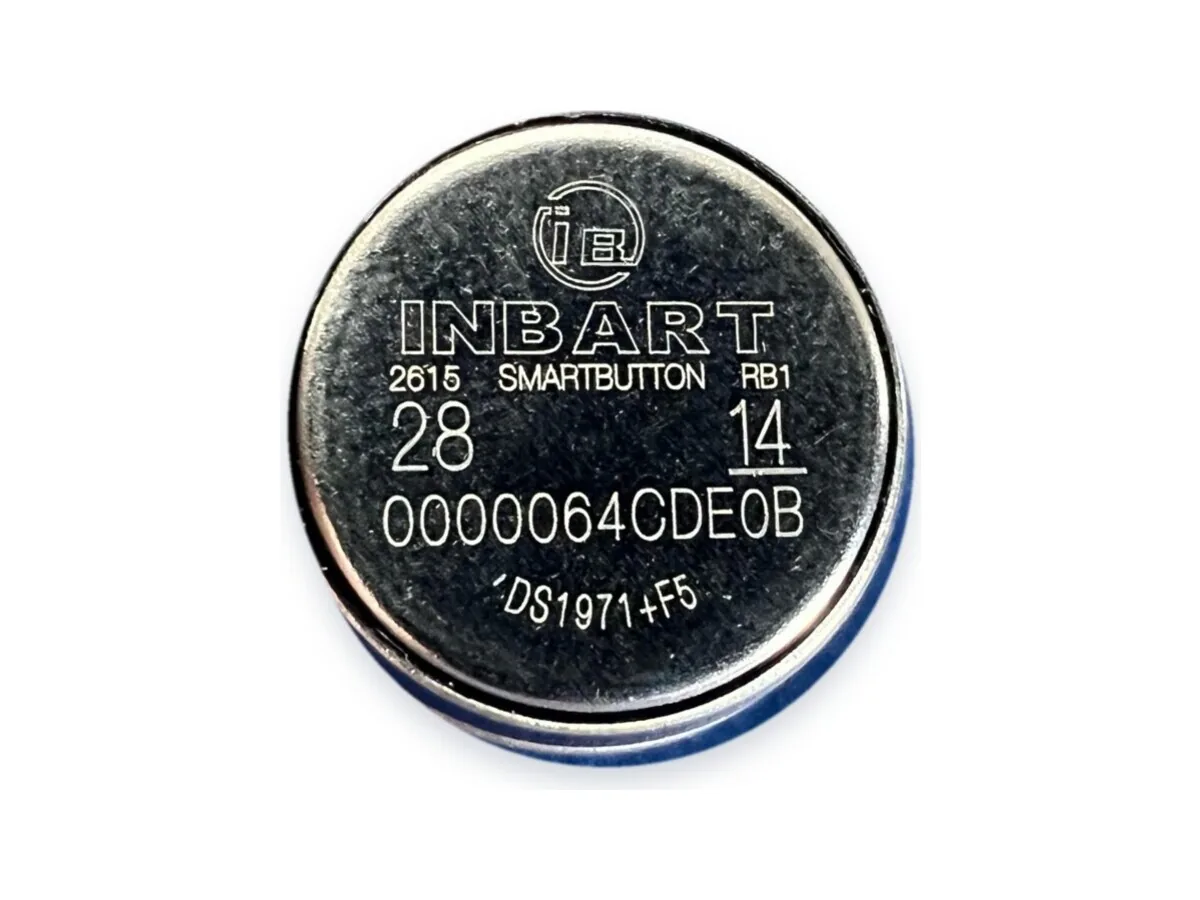
| DS1971 | 14h | 256 bit + 64-bit OTP | EEPROM — battery-free | Asset tag: a locked ID beside rewritable data |
| DS1972 | 2Dh | 1 Kbit (128 B) | EEPROM — battery-free | Per-page write-protect or EPROM-emulation modes |
| DS1973 | 23h | 4 Kbit (512 B) | EEPROM — battery-free | Largest battery-free memory; production travellers |
| DS1982 | 09h | 1 Kbit (128 B) | EPROM — add-only, cannot be erased | Tamper-evident checkpoints and certificates |
| DS1985 | 0Bh | 16 Kbit (2 KB) | EPROM — add-only, cannot be erased | Full append-only service history |
| DS1992 / DS1993 | 08h / 06h | 1 Kbit / 4 Kbit | NV RAM — battery-backed, unlimited writes | Data that changes constantly on the key |
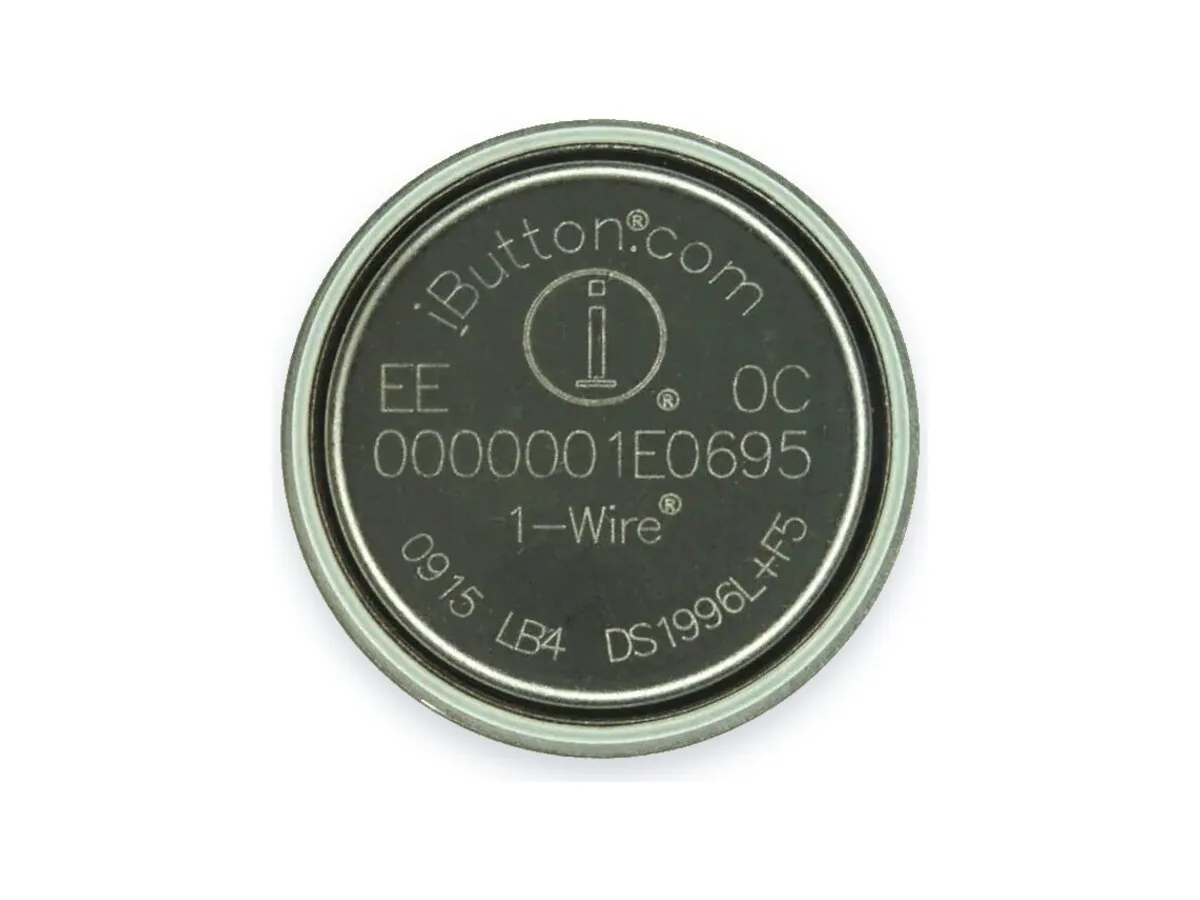
| DS1996 | 0Ch | 64 Kbit (8 KB) | NV RAM — battery-backed, unlimited writes | Portable database — the largest capacity here |
| DS1994 | 04h | 4 Kbit + RTC | NV RAM + clock, timer, counter, alarms | Time- or usage-limited access that expires by itself |
| DS1904L | 24h | No user memory | Real-time clock only | Give a microcontroller an accurate timebase |
| DS1991 | 02h | 1152 bit = 3 × 384 bit | Secure NV RAM — three password zones | Legacy multi-tenant systems (not for new secure designs) |
| DS1961S | 33h | 1 Kbit + 64-bit secret | EEPROM + SHA-1 challenge–response | The anti-cloning choice — proves it knows a secret |
Ordering information
| MOQ | 100 pcs |
|---|---|
| Lead time | 3–7 days for stock items, 10–15 days for OEM |
| Packing | Bulk ESD bags (100–200 pcs/bag, 2 bags/carton); blister or header cards for retail on request |
| Samples | Free samples for volume buyers — courier at cost |
| Payment | T/T bank transfer; other terms negotiable for repeat orders |
| Shipping | DHL / FedEx / UPS air express; sea or rail freight for pallet volumes |
| Customization | ROM ranges · housing colours · laser logo · private label |
Typical applications
Frequently asked questions
How does the DS1961S stop a key from being cloned?
By never revealing what makes it valid. Each device holds a 64-bit secret that is never transmitted on the bus. The reader sends a random challenge; the on-chip SHA-1 engine combines that challenge with the secret and the page data and returns a 160-bit MAC. Copying the 64-bit ROM ID onto a blank gets you a device that answers the challenge wrongly, so the controller rejects it. Writes are protected the same way — memory only updates when the command arrives with a matching MAC.
Will a DS1961S work in an ordinary iButton reader?
Physically yes, cryptographically no. It is a standard F5 can on the standard 1-Wire bus, so any reader will see it and read its 64-bit ROM ID — but a controller that only compares IDs gains none of the protection and treats it like a plain DS1990A. The security only exists if the host implements the SHA-1 challenge–response, usually with a 1-Wire SHA coprocessor. Confirm your controller supports it before ordering in volume.
What is the difference between the DS1961S and the DS2432?
They share the same silicon and 1 Kbit EEPROM with SHA-1 (family code 33h). The difference is packaging: the DS1961S is the rugged F5 MicroCan iButton, while the DS2432 is the chip form (TSOC or UCSP) for soldering onto a board.
What are typical uses for a SHA-1 iButton?
Hardware and IP authentication, anti-counterfeiting of consumables (print cartridges, medical or industrial disposables, batteries), secure access tokens and tamper-proof data carriers — anywhere the credential controls something worth attacking.
Related products
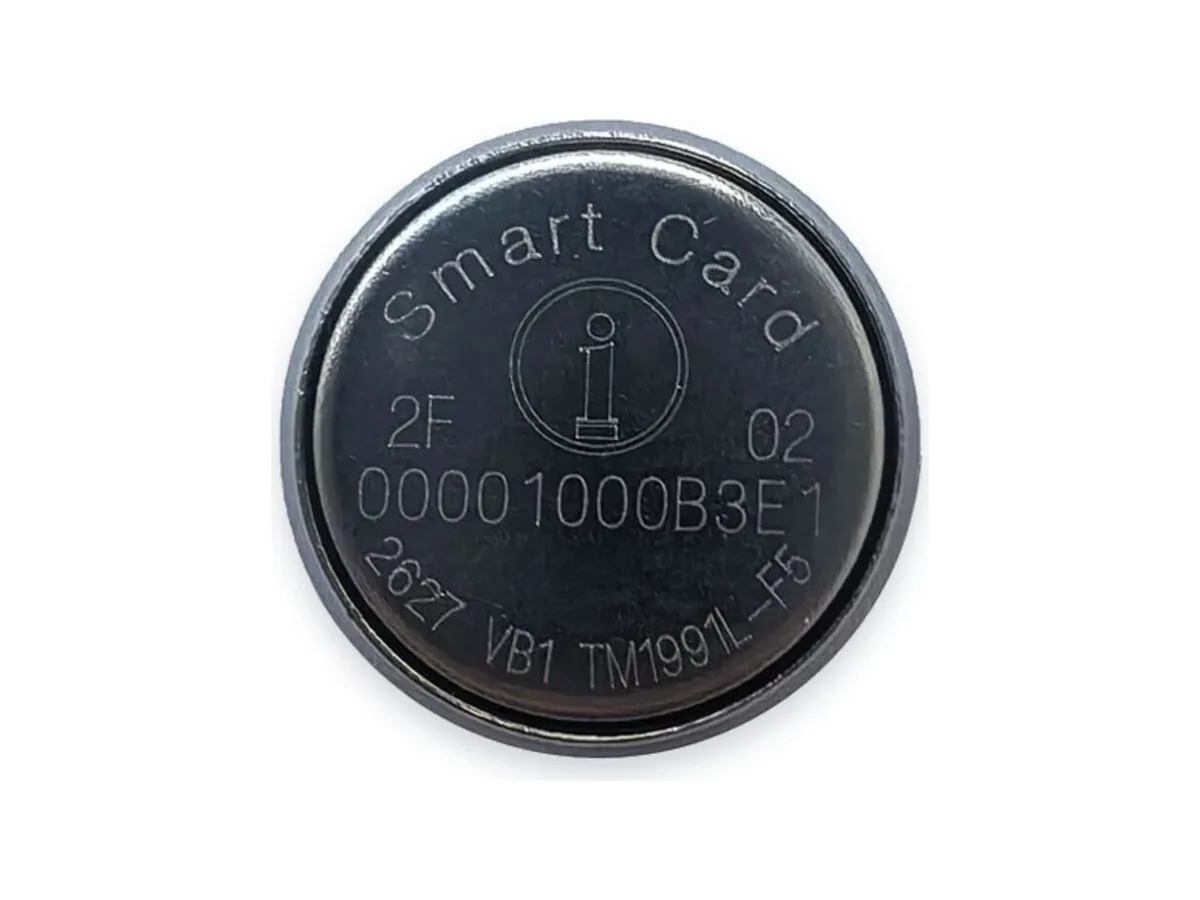
DS1991 MultiKey iButton
Three password-protected 384-bit subkeys in one button.
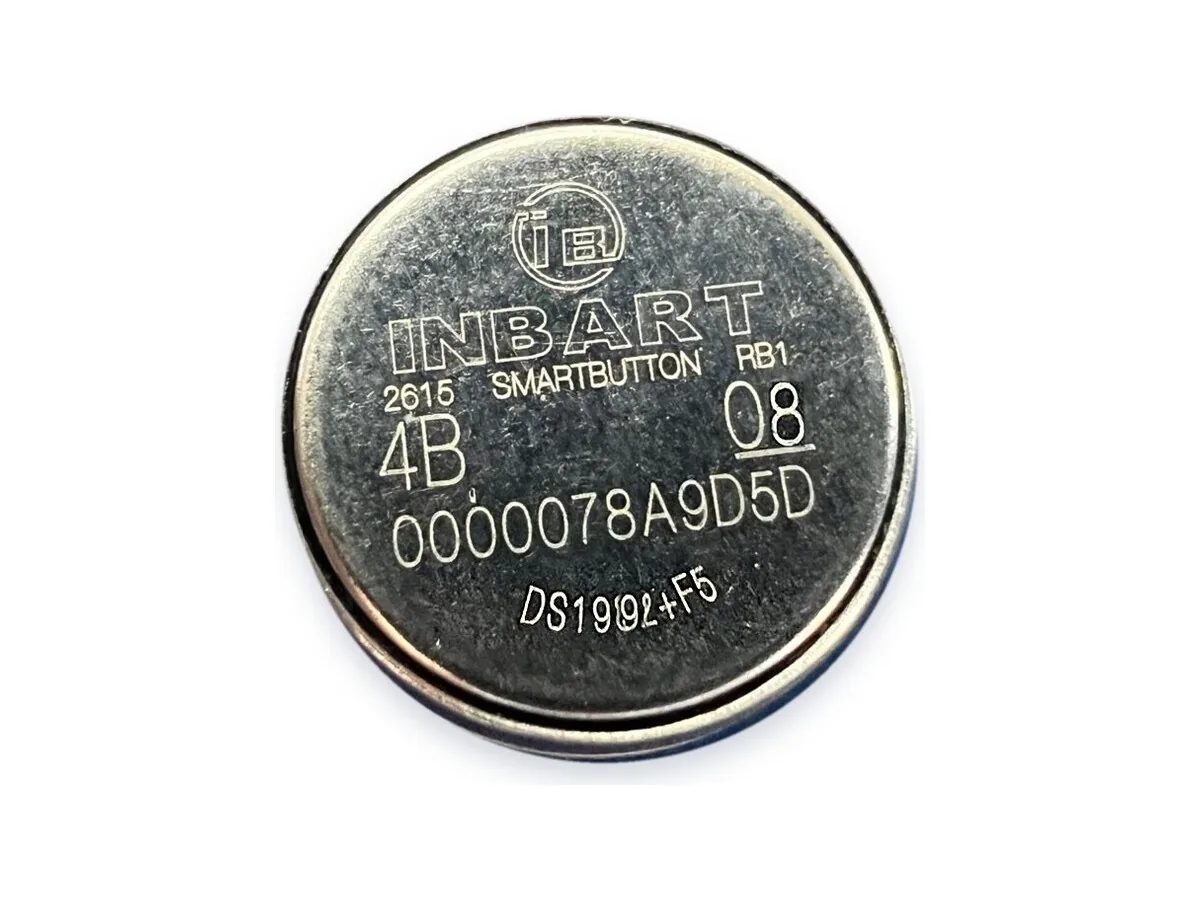
DS1992 / DS1993 Memory iButton
1 Kb and 4 Kb NV RAM tokens for carrying data on the key.
DS1996 64 Kb Memory iButton
The large-memory token — 64 Kb of rewritable NV RAM.
DS1971 EEPROM iButton
256-bit EEPROM — non-volatile without a battery.