DS1971 EEPROM iButton
256-bit EEPROM — non-volatile without a battery.
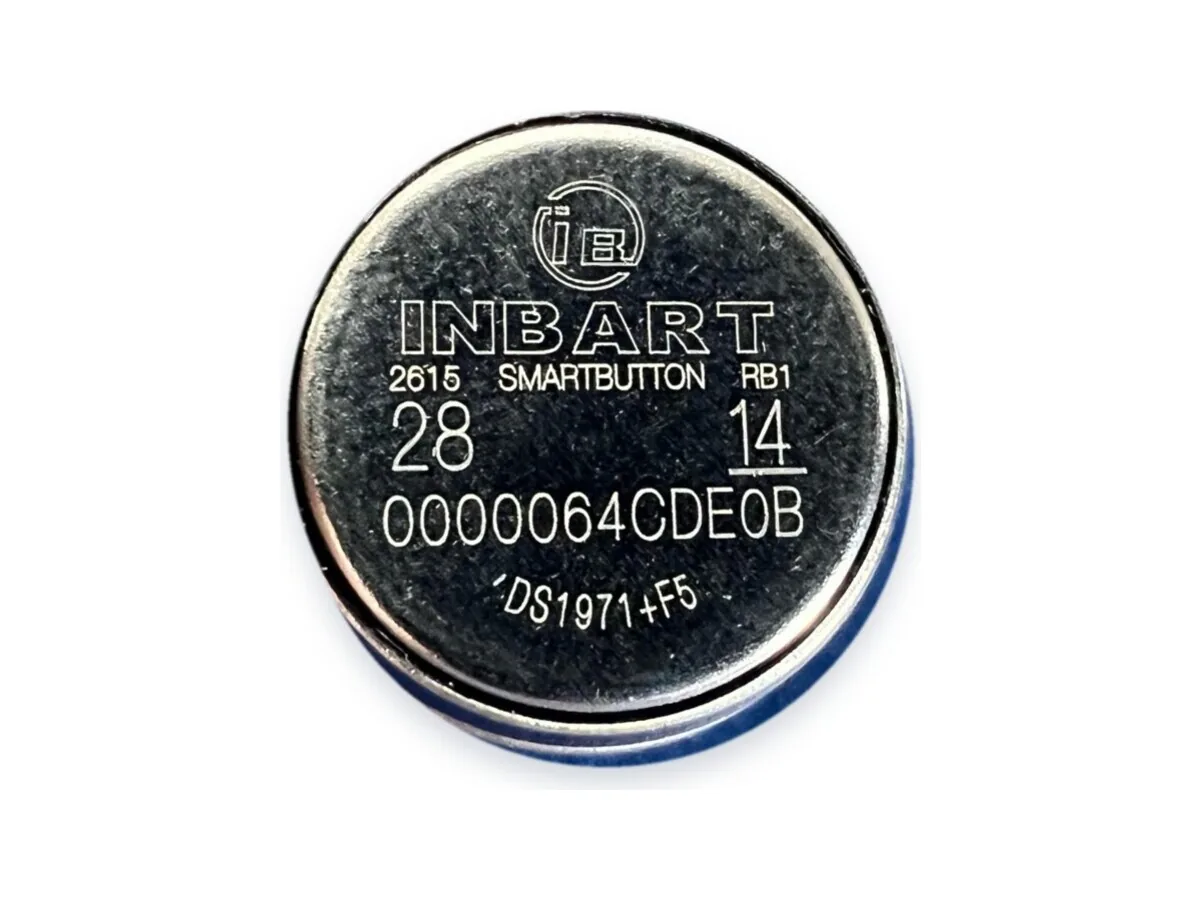
A small rewritable memory that pairs its EEPROM with a separate 64-bit one-time-programmable register. Write your permanent identifier into the OTP register and lock it, while the 256-bit EEPROM stays free for data you still need to change — a fixed asset number alongside a rewritable status field, in one battery-free button (data retention is specified in the original manufacturer's datasheet; confirm for the supplied version).
Ordering information
| MOQ | Confirmed by model and order when quoting |
|---|---|
| Preparation time | Availability and lead time are confirmed by model and order when quoting |
| Packing | Confirm pack quantity, protection and labelling for the selected model. |
| Samples | Sample quantity, fees and shipping are confirmed for the selected model. |
| Payment | Agree payment terms and the payee in the quotation and invoice. |
| Shipping | Confirm the shipping method, cost and timing for your destination and order. |
| Customization | State ROM, colour, marking and packing needs; feasibility and cost require confirmation. |
Rewritable data plus a lockable ID
The 64-bit OTP register is what sets it apart from the other EEPROM parts listed here: alongside memory you can change, it adds a small block you can program once and not alter, in the same device. That suits asset tagging — a fixed, one-time-programmed serial that field updates do not change, next to a scratch area the technician can rewrite. If you need more room, consider the DS1972 (1 Kb) or DS1973 (4 Kb); if you need everything to be permanent, consider the DS1982 add-only EPROM.
Key features
- Original DS1971 reference: 256-bit EEPROM, equal to 32 bytes of rewritable memory.
- The original also has a separate 64-bit one-time-programmable application register; it is not extra rewritable EEPROM.
- Confirm the full part number, register-lock procedure and host memory map before writing production data.
Specifications
| Chip / compatibility | DS1971 · family code 14h · shares its die with the DS2430A chip form |
|---|---|
| Memory | 256-bit EEPROM organized as a single 256-bit page + separate 64-bit one-time-programmable (OTP) register + 256-bit scratchpad · reads and writes from 2.8 V to 6.0 V (per the original manufacturer's datasheet; confirm for the supplied version) |
| Operating temperature | −40 to +85 °C · battery-free; data retention per the original manufacturer's datasheet (confirm for the supplied version) |
| Package | Stainless MicroCan, F5 size, Ø16.25 × 5.89 mm · approx. 3 g; the original manufacturer's datasheet describes it as rugged for harsh application environments |
| Protocol | 1-Wire® |
| Options | Colour, marking and other customization options: feasibility, MOQ and cost are confirmed in the quote. |
Product dimensions

Inside the stainless can
Typical construction of this can format: a stainless-steel shell, an insulating grommet separating lid from base, and the chip bonded inside. Lid = data contact, base = ground return. Wall thickness, grommet material and other construction details: confirm for the supplied version.
Which memory iButton do you need?
The whole memory range side by side, grouped by storage technology — capacities and family codes per the Analog Devices datasheets.
| Model | Family code | Capacity | Memory technology | Pick it for |
|---|---|---|---|---|
| DS1971 | 14h | 256 bit + 64-bit OTP | EEPROM — battery-free | Asset tag: a locked ID beside rewritable data |
| DS1972 | 2Dh | 1 Kbit (128 B) | EEPROM — battery-free | Per-page write-protect or EPROM-emulation modes |
| DS1973 | 23h | 4 Kbit (512 B) | EEPROM — battery-free | Battery-free rewritable memory (4 Kbit); production travellers |
| DS1982 | 09h | 1 Kbit (128 B) | EPROM — add-only; written data is not erasable (per datasheet) | Add-only records such as checkpoints and certificates |
| DS1985 | 0Bh | 16 Kbit (2 KB) | EPROM — add-only; written data is not erasable (per datasheet) | Append-only service history (16 Kbit) |
| DS1992 / DS1993 | 08h / 06h | 1 Kbit / 4 Kbit | NV RAM — battery-backed, high write endurance (per datasheet) | Data that changes constantly on the key |
| DS1996 | 0Ch | 64 Kbit (8 KB) | NV RAM — battery-backed, high write endurance (per datasheet) | Portable database — 64 Kbit NV RAM |
| DS1994 | 04h | 4 Kbit + RTC | NV RAM + clock, timer, counter, alarms | Time- or usage-limited access with the expiry held in the key |
| DS1904L | 24h | No user memory | Real-time clock only | Give a microcontroller a real-time timebase |
| DS1991 | 02h | 1152 bit = 3 × 384 bit | Secure NV RAM — three password zones | Legacy multi-tenant systems (not for new secure designs) |
| DS1961S | 33h | 1 Kbit + 64-bit secret | EEPROM + SHA-1 challenge–response | Authentication: proves it knows a secret (assess cloning risk for your own system) |
Typical applications
Frequently asked questions
What makes the DS1971 different from other EEPROM iButtons?
Per the original manufacturer's datasheet, it pairs rewritable EEPROM (256 bits) with a separate 64-bit one-time-programmable register that locks after writing — a permanent ID next to freely changeable data, in one battery-free button; confirm for the supplied version.
When do I step up to the DS1972 or DS1973?
Mainly on capacity: per the original manufacturer's datasheets, DS1971 holds 256 bits, DS1972 1 Kbit with per-page write-protect, DS1973 4 Kbit — sixteen times the space. If the OTP register is what you need, the DS1971 is the part to ask about; confirm for the supplied version.
Does it need a battery to keep data?
No — EEPROM is non-volatile and parasite-powered from the 1-Wire line, so there is no battery to go flat in storage. Per the original manufacturer's datasheet it reads and writes from 2.8 to 6.0 V with long data retention; confirm the retention figure for the supplied version.
Related products
DS1991 MultiKey iButton
Three password-protected 384-bit subkeys in one button.
DS1992 / DS1993 Memory iButton
1 Kb and 4 Kb NV RAM tokens for carrying data on the key.
DS1996 64 Kb Memory iButton
The large-memory token — 64 Kb of rewritable NV RAM.
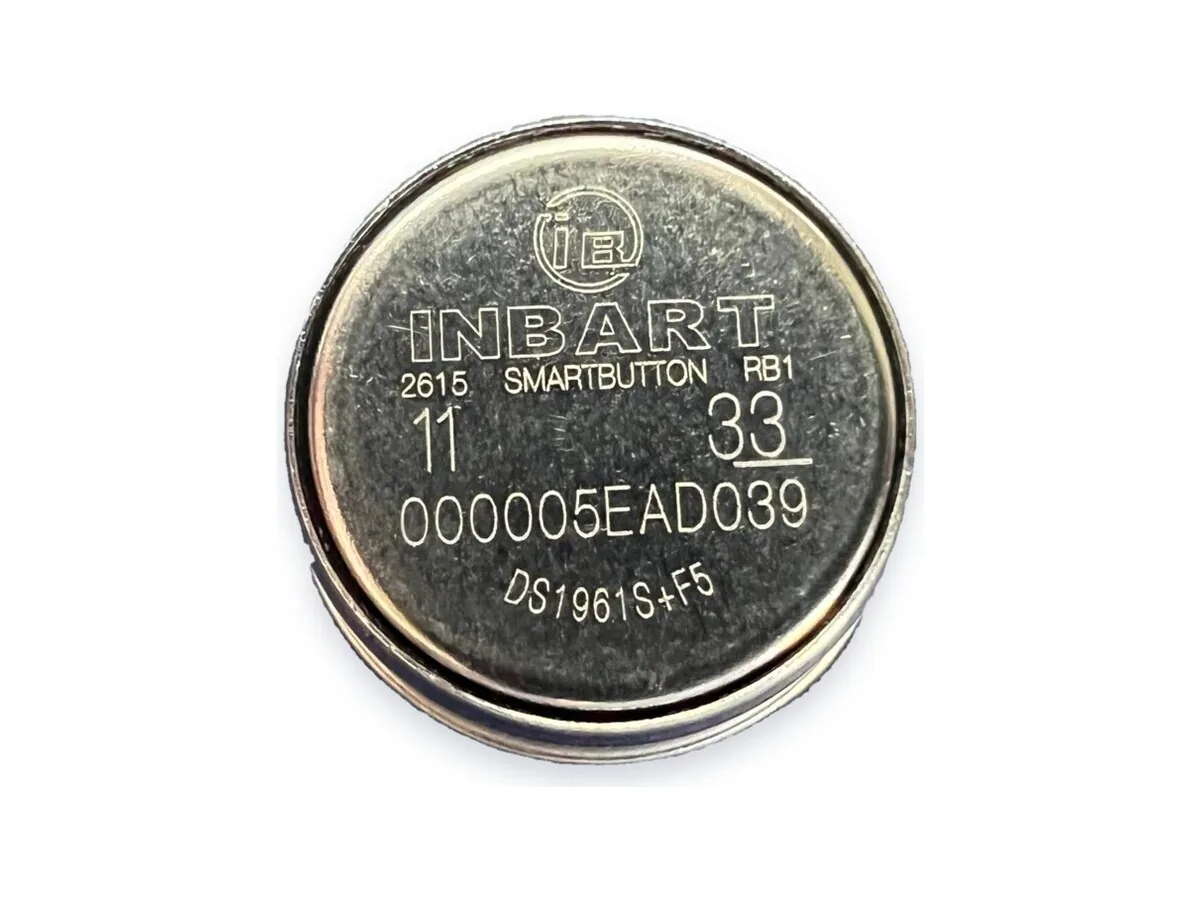
DS1961S SHA-1 Authentication iButton
1 Kb EEPROM with on-chip SHA-1 challenge–response.